Phrasal Verbs • Level A2-B1

Voices Across Distance

Phrasal Verbs Through Telephone History

Human Communication Theme

Master Phrasal Verbs Through Telephone History

1

Voices Across Distance

Learn phrasal verbs from Telephone history

You are here
2

TV - The Magic Box

Learn phrasal verbs from Television history

Start Learning
3

Computers – The Digital Leap

Learn phrasal verbs from Computers Hitory

Start Learning

Multimedia Learning Hub

🎥 Listen, watch and practise English with immersive videos, podcasts and shadowing

🎭 Phrasal Verbs Video Practice

English Story Video for Phrasal Verbs Practice
🌟 Explore All Themes
Discover story-based lessons, videos and interactive practice

🎙️ Story Podcast for Phrasal Verbs

Story Podcast for English Communication
🎯 Open the Phrasal Verbs Dictionary
Review advanced phrasal verbs with examples, meaning and practice
🏆

Your Progress

0
Correct
0
Incorrect
0%
Accuracy
0
Score
00:00
Study Time

🔊 Listen & Practice This Card — When Silence Learned to Speak Practice shadowing: read while listening and repeat. Then write down a few expressions or sentences that stood out to you.
Speed:
0:00 / 0:00
Ready to play
[
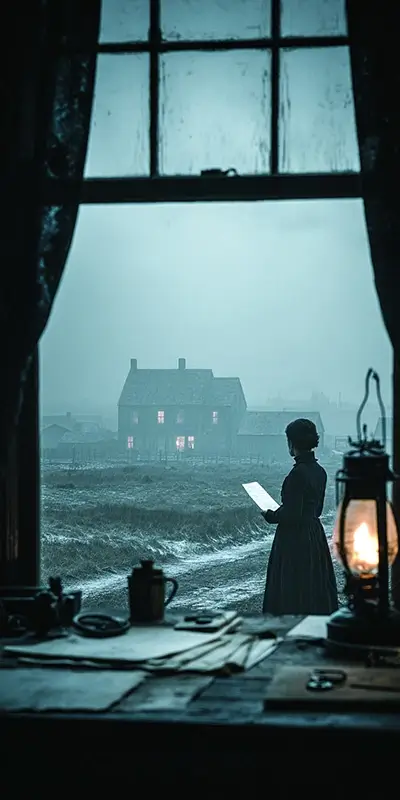
scene showing the emotional isolation of long-distance communication before the telephone. In the foreground, a woman stands by a wooden table inside a dimly lit candlelit room, holding a handwritten letter with a worried expression.
INTRO

When Silence Learned to Speak

Before the telephone, distance meant silence. You could write a letter and wait days — sometimes weeks — for a reply. You could reach out to someone you loved, but the connection was always delayed, always incomplete. For most of human history, keeping up with the people who mattered most required patience that most of us today would find almost unbearable.

Then, in the second half of the 19th century, something completely new came along. An invention was about to set off a revolution not just in communication, but in human relationships themselves. For the first time, two people separated by hundreds of miles could open up a real conversation — not through dots and dashes, but through the living sound of each other's voice.

The telephone didn't just break down the barriers of distance. It changed what it meant to connect with another person. You no longer had to hang up a letter and wait — you could pick up and talk, carry on a conversation in real time, and build on a relationship across any distance. Everything that came after — radio, television, the internet — gave way to a world the telephone first made imaginable.
🔊 Listen & Practice This Card — The Man Who Didn't Give Up Practice shadowing: read while listening and repeat. Then write down a few expressions or sentences that stood out to you.
Speed:
0:00 / 0:00
Ready to play
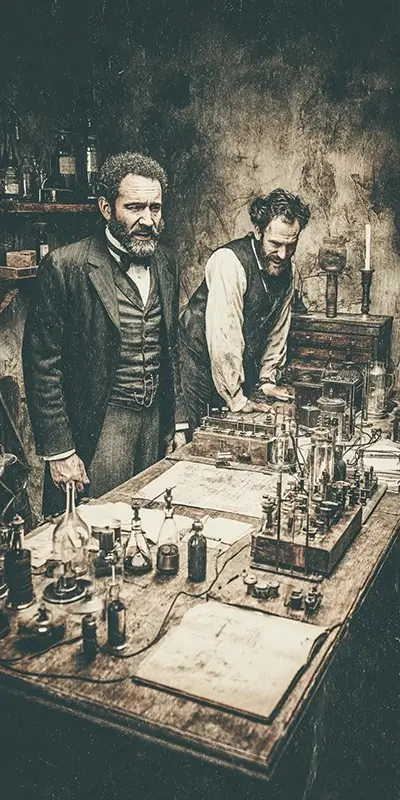
Alexander Graham Bell and Thomas Watson in a small Boston laboratory in 1876
INVENTION

The Man Who Didn't Give Up

Alexander Graham Bell had been working on the idea for years. He wasn't the only one going after it — inventors across America and Europe were all trying to figure out how to send voice through a wire. The race was intense, the stakes were enormous, and Bell knew that if he didn't push through, someone else would beat him to it. He set up a small laboratory in Boston with his assistant, Thomas Watson, and the two of them carried on experimenting even when results fell apart and funders pulled out.

On March 10, 1876, something clicked. Bell spilled some battery acid on his clothes and, almost by accident, called out to Watson through the device: "Mr. Watson — come here — I want to see you." Watson, in another room, picked up the receiver and heard the words come through — clear, unmistakable, human. They had pulled it off. What Bell wrote down in his notebook that night was almost too calm for the moment: the first telephone call in history, jotted down like a grocery list. But the world was already moving on to a completely different era.

Of course, bringing an invention about is one thing; getting it out into the world is another. Bell took on the challenge of pitching his device to investors, demonstrators, and even skeptics who brushed it off as a toy or a trick. The Western Union telegraph company turned down his offer to sell the patent for $100,000 — a decision they would look back on as one of the worst in business history. Bell didn't give up. He set up the Bell Telephone Company in 1877 and went on to build up one of the most powerful communication empires ever seen.

🔊 Listen & Practice This Card — The Women Who Put You Through Practice shadowing: read while listening and repeat. Then write down a few expressions or sentences that stood out to you.
Speed:
0:00 / 0:00
Ready to play
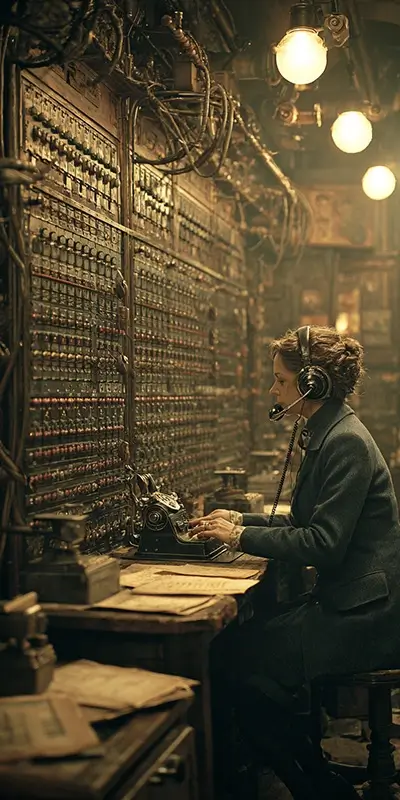
Historical scene of a female telephone operator in the late 1880s sitting at a large manual switchboard
PEOPLE

The Women Who Put You Through

Here's something that often gets left out of the telephone story: the device didn't work alone. In the early days, you couldn't dial up anyone directly. You picked up the receiver and waited for an operator to come on the line. That operator — almost always a woman by the 1880s — would take down the name of who you wanted to reach, look it up in a directory, plug in the cables, and physically connect you through to the other line. Without her, the whole system broke down. She wasn't just an assistant. She was the network.

These women took on an extraordinary job. They had to keep up with thousands of numbers, deal with impatient callers, sort out wrong connections, and hold up under the pressure of emergencies — fires, accidents, medical crises — all coming in at once. Many communities relied on their local operator for more than just calls. She kept track of who was sick, who had passed away, which roads had washed out after a storm. She was, in many towns, the living memory of the community.

The operators' era wound down gradually as automatic switching systems came in through the early 20th century. Rotary dials took over, letting callers connect directly without going through a human intermediary. It was more efficient, no doubt — but something quietly slipped away. The warmth of a familiar voice checking in on the other end, asking after your family, making sure you got through safely — that went away when automation took over. Progress has a way of giving things up without quite realizing what it's letting go of.

🔊 Listen & Practice This Card — When the Telephone Took Over Practice shadowing: read while listening and repeat. Then write down a few expressions or sentences that stood out to you.
Speed:
0:00 / 0:00
Ready to play
a young woman sitting on the floor of her bedroom talking on a corded landline telephone
SOCIETY

When the Telephone Took Over

Once the telephone caught on, it spread out faster than almost anyone had counted on. Businesses were the first to jump on the opportunity — suddenly, a manager in New York could get through to a supplier in Chicago without setting up a meeting or waiting around for a telegram reply. Deals that used to drag on for weeks wrapped up in an afternoon. Companies that held back from adopting the telephone fell behind their competitors almost immediately. The business world turned into something faster, more connected, and far more demanding.

But the changes went beyond the boardroom. Families spread out across cities started checking in regularly — Sunday calls became rituals, keeping relationships alive across distances that used to wear them down. Emergency services woke up to the potential: by the early 1900s, fire departments and police were hooking up direct lines, cutting down response times dramatically. Doctors could call in consultations. Neighbors could look out for each other without leaving their homes. The telephone wove itself into the fabric of daily life so completely that it became invisible — just something that had always been there, holding everything together.

It also brought about some surprises no one had bargained for. Privacy went out the window in small towns where party lines — shared telephone wires — meant your neighbors could listen in on your conversations any time they felt like it. Businesses had to work out new etiquette: how do you end a call properly? What do you say when you pick up? (The word "hello," by the way, was put forward by Thomas Edison specifically for telephone greetings — before that, people didn't know how to start off a call.) The telephone didn't just slot into existing habits. It called for entirely new ones.

🔊 Listen & Practice This Card — From the Wall to the World Practice shadowing: read while listening and repeat. Then write down a few expressions or sentences that stood out to you.
Speed:
0:00 / 0:00
Ready to play
A nostalgic 1990s street scene featuring an iconic public payphone on a sidewalk at dusk
CONCLUSION

From the Wall to the World

By the mid-20th century, the telephone had settled into everyday life so deeply that it was hard to picture a home without one. The rotary dial gave way to push buttons. Party lines phased out as private lines became standard. Long-distance calls — once a luxury people saved up for and psyched themselves up for like a small event — came down in price until they were almost ordinary. The telephone had moved on from novelty to necessity to furniture: something you walked past a hundred times a day without giving it a second thought.

Then, quietly, something new started coming together in research labs and university departments. The same engineers who had grown up with telephones began thinking up ways to link up computers — massive, room-sized machines that took up entire floors of university buildings — into networks that could pass information along at incredible speeds. In the 1980s, students and researchers plugged in their terminals and logged on to systems that few outside academia had even heard of. They were laying the groundwork for something that would make even the telephone look like a warm-up act.

And then came the 1990s. Windows showed up on home computers. The internet opened up to the public. People signed up for email addresses and started reaching out to strangers on the other side of the planet. The world that Bell had set in motion in 1876 — the idea that distance shouldn't stand in the way of human connection — was speeding up to a pace no one had bargained for. The wire had become wireless. The voice had turned into data. And the telephone? It was about to transform into something that fit in your pocket and opened up the entire world.

Complete the Gaps — The Telephone (Phrasal Verbs)

Tap the blanks and choose the correct option.

Question 1:
Bell _________ the receiver and _________ Watson through the device for the very first time.
Question 2:
The telephone operator would _________ the name of who you wanted to reach and _________ it _________ in a directory.
Question 3:
Before the telephone, distance could completely _________ people _________ from each other — news arrived days after it mattered.
Question 4:
Companies that _________ from adopting the telephone quickly _________ their competitors.
Question 5:
People had _________ ways to _________ the problem, but the telegraph still required a trained operator on both ends.
Question 6:
The rotary dial _________ push buttons, and long-distance calls _________ in price until they were almost ordinary.
Question 7:
Once the telephone _________, businesses were the first to _________ the opportunity.
Question 8:
Bell and Watson _________ experimenting even when results _________ and funders pulled out.
Question 9:
Bell knew that if he didn't _________, someone else would beat him to the invention.
Question 10:
The word 'hello' was _________ by Thomas Edison specifically so people would know how to _________ a telephone call.
Question 11:
Western Union _________ Bell's offer to buy the patent — a decision they would always _________ as their biggest mistake.
Question 12:
These women had to _________ with thousands of numbers and _________ the pressure of emergencies all coming in at once.
Score: 0/12 questions correct (0%)
Alessandra Fernandes Nóbrega
History teacher and educational content creator. M.A. in History of Education (UFPB). Creator of WeeklyCross, FlipVerbs and Flowglish — a connected ecosystem for learning English through context, not memorisation. Trained in educational entrepreneurship in Finland.

WeeklyCross teaches phrasal verbs through historical and cultural context. Each lesson connects to vocabulary practice on FlipVerbs and fluency levels on Flowglish — forming a complete learning ecosystem.

0%
Scroll to Top