Phrasal Verbs • Level A2-B1

Computers – The Digital Leap

Phrasal Verbs Through Computers History

Human Communication Theme

Master Phrasal Verbs Through Computers History

1

Voices Across Distance

Learn phrasal verbs from Telephone history

Start Learning
2

TV - The Magic Box

Learn phrasal verbs from Television history

Start Learning
3

Computers – The Digital Leap

Learn phrasal verbs from Computers Hitory

You are here

Multimedia Learning Hub

🎥 Listen, watch and practise English with immersive videos, podcasts and shadowing

🎭 Phrasal Verbs Video Practice

English Story Video for Phrasal Verbs Practice
🌟 Explore All Themes
Discover story-based lessons, videos and interactive practice

🎙️ Story Podcast for Phrasal Verbs

Story Podcast for English Communication
🎯 Open the Phrasal Verbs Dictionary
Review advanced phrasal verbs with examples, meaning and practice
🏆

Your Progress

0
Correct
0
Incorrect
0%
Accuracy
0
Score
00:00
Study Time

🔊 Listen & Practice This Card — The Machine That Changed Everything Practice shadowing: read while listening and repeat. Then write down a few expressions or sentences that stood out to you.
Speed:
0:00 / 0:00
Ready to play
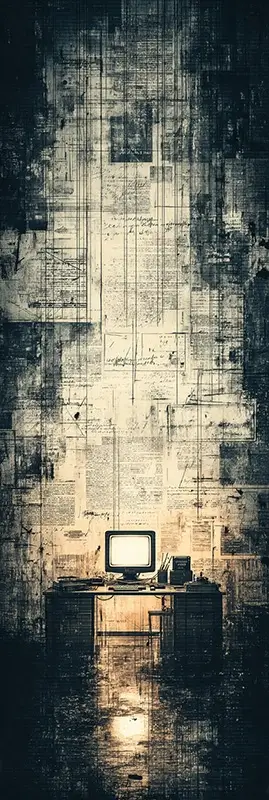
At the center of the image stands a glowing computer as the main symbol of transformation. Around it, are visual traces of older communication methods handwritten letters, newspapers, telephone wires, rotary phones, printed documents, and physical networks.
INTRO

The Machine That Changed Everything

Think about the last time you logged on to check your messages, looked up a word you didn't know, or relied on a search engine to carry out a quick task. Chances are, you did all of that without even thinking about it. But this wasn't always the case — and understanding how we got here is a fascinating journey.

If we go back just a few decades, people had to figure out entirely different ways to communicate. They came up with workarounds, built up networks using physical infrastructure, and passed on information through letters, printed newspapers, and telephone calls. The idea of instant global communication was pure science fiction.

Then computers took on a role no one had fully anticipated. What began as calculating machines broke through the walls of laboratories and grew into something much bigger. That transformation led to a communication revolution — and opened up a world where distance no longer determined who you could talk to.
🔊 Listen & Practice This Card — Giants in the Room: Early Computers and the First Networks Practice shadowing: read while listening and repeat. Then write down a few expressions or sentences that stood out to you.
Speed:
0:00 / 0:00
Ready to play
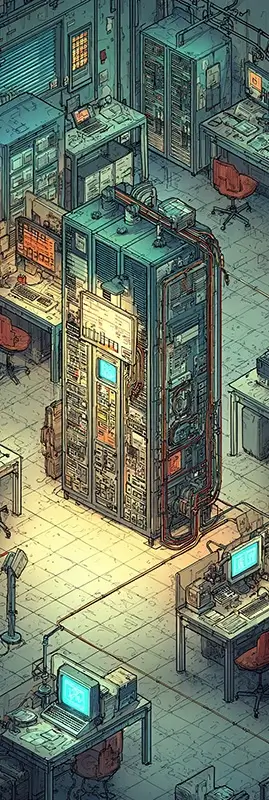
illustration showing the early age of networked computing
CARD 2

Giants in the Room: Early Computers and the First Networks

The first computers took up entire rooms. Teams of scientists set up these massive machines to carry out mathematical calculations — and if something went wrong, the whole system could shut down without warning. Working out what had failed often took days. These were not personal devices by any measure.

By the late 1960s, researchers began to connect to each other through a network called ARPANET. For the first time, a scientist could log in from one university and reach out to a colleague miles away. This slowly built up a culture of networked communication — a world where institutions could break into each other's knowledge bases and share what they knew.

Companies soon began to set up their own internal networks — intranets — that brought in employees across departments. Outsiders were locked out, but inside those walls, workers could share out files and collaborate in real time. Without anyone quite planning it, the office computer was turning into a communication hub.

🔊 Listen & Practice This Card — The Windows Revolution: Computers for Everyone Practice shadowing: read while listening and repeat. Then write down a few expressions or sentences that stood out to you.
Speed:
0:00 / 0:00
Ready to play
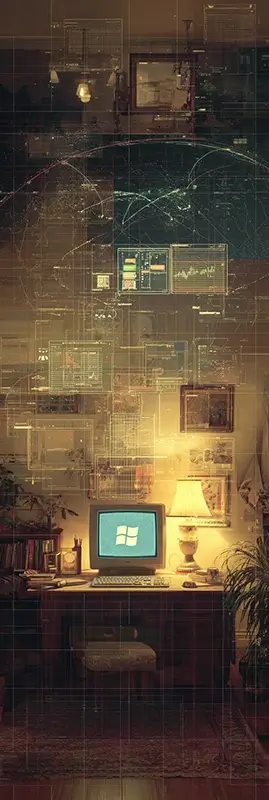
scene centered on a 1990s desktop computer with a glowing Windows-style interface
CARD 3

The Windows Revolution: Computers for Everyone

Before Windows, using a computer meant typing in commands and figuring out the right syntax by memory. There were no icons to point at, no folders to click on — just a blinking cursor on a black screen. When graphical interfaces opened up a new way of interacting with machines, everything changed. Suddenly, you didn't need to be an engineer to use a computer.

When Windows 95 came out, it became a cultural phenomenon almost overnight. Sales took off immediately, and families who had never owned a computer began to log on for the first time. You could scroll through web pages, look up information, and send emails — all with a click of a mouse. The internet was no longer for specialists; it was for everyone.

What this meant for communication was enormous. You could reach out to someone on the other side of the world in seconds. Businesses sent out newsletters by email instead of post. Old friends caught up with each other through online forums. You could plug in at home, tune in to a website from another country, and feel — for the first time — genuinely connected to a global conversation.

🔊 Listen & Practice This Card — Untethered: Laptops, Wi-Fi, and the Always-Connected World Practice shadowing: read while listening and repeat. Then write down a few expressions or sentences that stood out to you.
Speed:
0:00 / 0:00
Ready to play
image of a modern person seated in a contemporary café or travel lounge, illuminated by the soft glow of a laptop and smartphone
CARD 4

Untethered: Laptops, Wi-Fi, and the Always-Connected World

The laptop changed the rules entirely. For the first time, you could take your computer along wherever you went — to a café, a park, an airport lounge. You didn't need to set up a desk or plug in a cable to hook up to the internet. Wi-Fi meant the connection was already there, invisible and waiting. Computing had become truly portable.

Smartphones made things even more immediate. You could sign up for a new platform in seconds, scroll through a news feed on the bus, and have messages show up on your screen the moment someone sent them. You'd switch on your phone first thing in the morning and find yourself already loaded up with notifications, updates, and replies from people around the world.

Today, artificial intelligence is coming up with new ways to assist communication — translating languages in real time and powering tools that would have seemed impossible a decade ago. Digital technology has taken over almost every aspect of how we share information, and it keeps speeding up, growing into something that opens up new possibilities every year.

🔊 Listen & Practice This Card — From Room-Sized to Pocket-Sized Practice shadowing: read while listening and repeat. Then write down a few expressions or sentences that stood out to you.
Speed:
0:00 / 0:00
Ready to play
a person at a computer in the foreground, while behind and around them the digital world opens into a vast global communication network.
CONCLUSION

From Room-Sized to Pocket-Sized — and Beyond

All of this progress came from one simple idea: that machines could carry on tasks that humans found tedious, and eventually move on to tasks humans found impossible. Step by step, that idea built up into a global infrastructure — and grew into the digital world we live in today. The scale of the transformation is almost hard to take in.

But behind every technological leap is a deeply human motivation: the desire to reach out, to pass on ideas, to connect with people we care about. Every time someone logs on — whether in a school in Brazil, an office in Japan, or a home in Nigeria — they are opening up a channel that links them to billions of others. Computers made that possible in a way that nothing before them ever did.

As you look up new vocabulary, figure out how phrasal verbs work, and keep up with the topics in this hub, remember that language is technology too — one of the oldest kinds. You are building on thousands of years of human communication, using the tools of the present to carry on a conversation that began long before any of us were here.

Interpretive Quiz — Computers & the Digital Age
Read carefully and choose the best answer
Question 1/10
Score: 0/10
According to the text, what was the main purpose of the first computers?
0/10
Well done!
Alessandra Fernandes Nóbrega
History teacher and educational content creator. M.A. in History of Education (UFPB). Creator of WeeklyCross, FlipVerbs and Flowglish — a connected ecosystem for learning English through context, not memorisation. Trained in educational entrepreneurship in Finland.

WeeklyCross teaches phrasal verbs through historical and cultural context. Each lesson connects to vocabulary practice on FlipVerbs and fluency levels on Flowglish — forming a complete learning ecosystem.

0%
Scroll to Top