Phrasal Verbs in Context
Tiny House Hub

Big questions, tiny answers


Tiny House Hub:

Alternative Communities and Camping Life
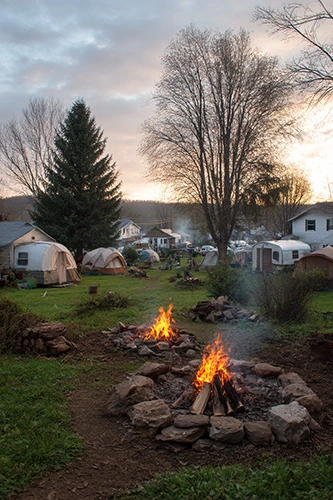

Learn phrasal verbs to talk about Alternative Communities and Camping Life

Level: Upper-Intermediate to Advanced (B2-C1)


๐Ÿ  Phrasal Verbs in Context: Alternative Communities and Camping Life

people are choosing to live together in intentional communities, ecovillages, and permanent campgrounds--redefining what it means to belong

Welcome to Alternative Communities and Camping Life, a lesson where we explore how people are choosing to live together in intentional communities, ecovillages, and permanent campgroundsโ€”redefining what it means to belong. In a world where loneliness has become an epidemic, many are seeking out alternatives to isolated suburban life. They're moving into communities where neighbors actually know each other, where resources are shared out, and where people look out for one another. Some settle down in ecovillages with strict environmental principles. Others end up in campgrounds that slowly became permanent homes.

In this lesson, you'll discover why people give up privacy and independence to join in collective living. You'll learn how these communities are set up, what rules they come up with, and how members work through conflicts. And you'll explore whether this lifestyle might be the answer to modern disconnection.
Multimedia Learning Hub

๐ŸŽฅ Listen, watch and practise English with immersive videos, podcasts and shadowing

๐ŸŽญ Phrasal Verbs Video Practice

English Story Video for Phrasal Verbs Practice
๐ŸŒŸ Explore All Themes
Discover story-based lessons, videos and interactive practice

๐ŸŽ™๏ธ Story Podcast for Phrasal Verbs

Story Podcast for English Communication
๐ŸŽฏ Open the Phrasal Verbs Dictionary
Review advanced phrasal verbs with examples, meaning and practice
๐Ÿ†

Your Progress

0
Correct
0
Incorrect
0%
Accuracy
0
Score
00:00
Study Time

๐Ÿ”Š Listen & Practice This Card โ€” ๐ŸŽง Listen to Section 1 Practice shadowing: read while listening and repeat. Then write down a few expressions or sentences that stood out to you.
Speed:
0:00 / 0:00
Ready to play

๐Ÿ  The Search for Belonging โ€” Why People Choose Community

The decision to join an intentional community often grows out of a deep sense of disconnection. Modern life has a way of cutting people off from meaningful relationships. Neighbors move in and out without ever exchanging more than a wave. Families are spread out across different cities or countries. Social media promises connection but often leaves people feeling more alone than ever.

At some point, many start looking for something differentโ€”a place where belonging isn’t something you have to work at alone.

The appeal of community living goes beyond just having neighbors. It’s about building up a support network that traditional society no longer provides. In intentional communities, people pitch in when someone is sick, chip in for shared expenses, and step up when help is needed. Children grow up surrounded by adults who care about them. Elderly members are looked after by the group rather than sent off to institutions.

For many, the search for community is also tied to environmental values.

They want to cut back on consumption, do away with wasteful lifestyles, and live in harmony with nature. Sharing resourcesโ€”tools, vehicles, even mealsโ€”adds up to significant environmental savings. A community garden can provide for dozens of families. Solar panels shared among neighbors cost less per household. The collective approach turns out to be both ecologically responsible and economically smart.

๐Ÿ”Š Listen & Practice This Card โ€” ๐ŸŽง Listen to Section 2 Practice shadowing: read while listening and repeat. Then write down a few expressions or sentences that stood out to you.
Speed:
0:00 / 0:00
Ready to play

๐Ÿ  Life in Intentional Communities โ€” Rules, Roles, and Reality

Living in an intentional community isn’t as simple as just showing up and fitting in. Most communities have developed careful systems that new members must go through before being accepted. Trial periods can go on for anywhere from a few weeks to a full year. During this time, potential members find out whether the community’s values line up with their own, while existing members figure out whether the newcomer will fit into the group dynamic.

Every community must work out how decisions will be made. Some opt for consensus, where every member must sign off on major choices.

Others settle on voting systems or elected councils. Tasks must be divided up fairlyโ€”cooking, cleaning, gardening, maintenance. Members take turns or sign up for roles that match their skills. When someone doesn’t pull their weight, the community must deal with it collectively.

Conflict is inevitable when people live closely together. Successful communities don’t try to brush off disagreementsโ€”they bring them out into the open.

Regular meetings allow members to speak up about concerns before resentment builds up. Many communities draw on mediation techniques, bringing in neutral parties to help people talk through disputes. The goal isn’t to smooth over differences but to work through them honestly, strengthening bonds in the process.

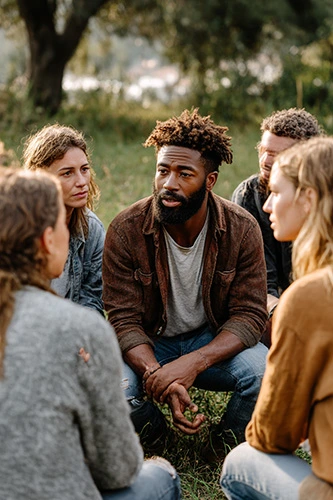
A small group of adult people sitting in a circle outdoors, one person speaking while others listen attentively
๐Ÿ”Š Listen & Practice This Card โ€” ๐ŸŽง Listen to Section 3 Practice shadowing: read while listening and repeat. Then write down a few expressions or sentences that stood out to you.
Speed:
0:00 / 0:00
Ready to play

๐Ÿ  Campground Living โ€” When Temporary Becomes Permanent

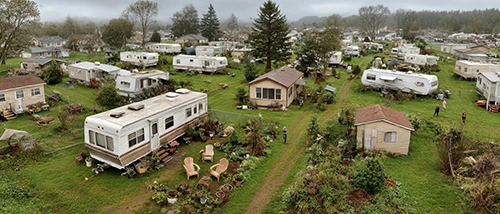
Aerial view from a drone. A year-round campground with trailers and RVs arranged like a small neighborhood, outdoor chairs, plants and personal items visible.

Not all alternative communities are planned. Some spring up organically in places never intended for permanent living. Campgrounds across America and Europe have quietly turned into year-round neighborhoods. What begins as a temporary arrangementโ€”staying on after a job loss, holding out until finances improveโ€”often stretches out into years. Eventually, residents stop thinking of it as camping and start settling into it as home.

Life in a permanent campground requires residents to make do with far less than conventional housing offers. Trailers and RVs must be kept up despite limited resources. Utilities can be unreliableโ€”water runs out, electricity goes out, heating systems break down. But residents come together to help each other. Someone who knows plumbing fixes up a neighbor’s pipes.

Another who’s handy with electricity sorts out wiring problems. Skills are traded rather than paid for. Despite the challenges, many campground residents wouldn’t trade their lifestyle for a conventional apartment. The sense of community makes up for the lack of space. Children run around freely between sites while adults look on from lawn chairs.

Evening barbecues bring together people from different backgrounds who might never have crossed paths otherwise. For those who have dropped out of mainstream housing marketsโ€”whether by choice or circumstanceโ€”these informal communities offer something increasingly rare: neighbors who actually show up for each other.

๐Ÿ”Š Listen & Practice This Card โ€” ๐ŸŽง Listen to Conclusion Practice shadowing: read while listening and repeat. Then write down a few expressions or sentences that stood out to you.
Speed:
0:00 / 0:00
Ready to play

๐Ÿ  Finding Your Tribe โ€” The Future of Collective Living

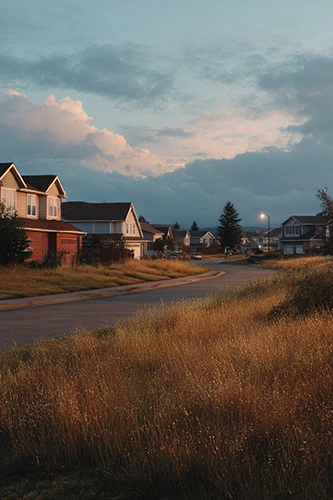
A quiet suburban neighborhood at dusk, empty streets and closed houses, high grass, a feeling of abandonment, soft fading light, calm and reflective mood.

The growth of intentional communities and campground living points to something fundamental missing in modern life. As traditional support systems have broken downโ€”extended families split up, neighborhoods emptied out, religious communities faded awayโ€”people have had to come up with new ways of looking after one another. These alternative communities represent experiments in rebuilding what was lost. Not everyone is cut out for collective living. It requires giving up a degree of privacy and autonomy that many aren’t willing to sacrifice.

Conflicts must be faced up to rather than avoided. Personal preferences sometimes have to give way to group decisions. Those who stick it out discover that the rewardsโ€”deep friendships, shared purpose, genuine securityโ€”outweigh the compromises. Whether in a carefully planned ecovillage or a makeshift campground community, people are reaching out to reconnect with something ancient: the tribe. In a world that keeps speeding up and spreading out, these communities offer a chance to slow down and draw together.

They remind us that humans weren’t meant to go through life aloneโ€”and that sometimes, the best way forward is to band together with others who share the same vision of a different way to live.

Alternative Communities & Camping Life Quiz
Read carefully and choose the best answer
Question 1/10
Score: 0/10
What does 'seek out' mean in: 'many are seeking out alternatives to isolated suburban life'?
0/10
Well done!
๐Ÿ‘ฅ

Join Our Community!

Study the phrasal verbs on this page and then join our community with suggestions, comments, and learning

f Join the Community
0%
Scroll to Top