Phrasal Verbs in Context
Tiny House Hub

Big questions, tiny answers


🏠 Phrasal Verbs in Context: Off-Grid Living
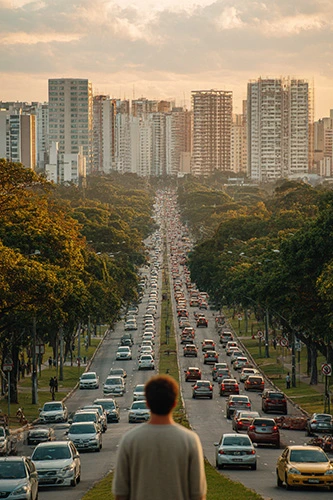
A person looking at an avenue full of buildings, standing on the center median with cars passing in both directions

Welcome to Off-Grid Living: Back to Nature, a lesson where we explore one of the most radical lifestyle shifts of our time: leaving the city behind to build a self-sufficient life in the countryside. For decades, modern life has been speeding up. Bills pile up, commutes eat into our free time, and the noise of urban living never quite dies down. But a growing number of people are choosing to break away from this cycle entirely. They're not just downsizing—they're opting out of the grid itself.

Although living off-grid may seem like a great adventure, it's an experience that brings about major ruptures in the Western lifestyle. You have to be prepared to give up the conveniences a city offers—and even the noise and hustle that surrounds you everywhere. The encounter with yourself and the courage to deal with unexpected situations, however, can strengthen your sense of presence and bring you closer to a deep connection with Nature. In this lesson, you'll discover why people are giving up stable jobs and comfortable homes to start over in remote places. You'll learn how they set up solar panels, dig wells, and grow their own food.

And you'll explore the emotional journey of cutting ties with everything familiar to find a different kind of freedom.
Multimedia Learning Hub

🎥 Listen, watch and practise English with immersive videos, podcasts and shadowing

🎭 Phrasal Verbs Video Practice

English Story Video for Phrasal Verbs Practice
🌟 Explore All Themes
Discover story-based lessons, videos and interactive practice

🎙️ Story Podcast for Phrasal Verbs

Story Podcast for English Communication
🎯 Open the Phrasal Verbs Dictionary
Review advanced phrasal verbs with examples, meaning and practice
🏆

Your Progress

0
Correct
0
Incorrect
0%
Accuracy
0
Score
00:00
Study Time

🔊 Listen & Practice This Card — 🎧The Call of the Wild — Why People Leave Everything Behind Practice shadowing: read while listening and repeat. Then write down a few expressions or sentences that stood out to you.
Speed:
0:00 / 0:00
Ready to play

🏠 The Call of the Wild — Why People Leave Everything Behind

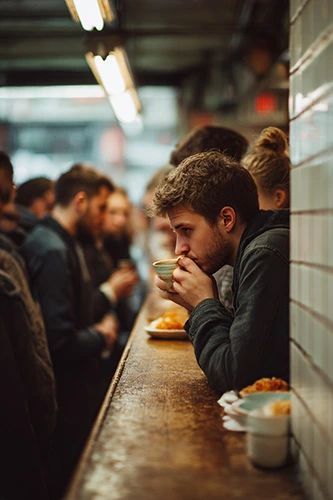
A single person standing at a narrow bakery counter in a busy city, drinking coffee quickly from a small ceramic cup. Morning rush atmosphere. Other customers blurred in motion behind them, city noise implied. Fluorescent lighting, tiled walls, worn wooden counter. The person looks thoughtful and slightly tired, staring into the coffee

The decision to go off-grid rarely **comes about** overnight. For most people, it **builds up** slowly—a growing sense that something fundamental isn’t working. The alarm **goes off** at the same time every morning, the same commute **eats away at** the same hours, and the paycheck barely covers the bills that keep **piling up**. At some point, a question **creeps in**: Is this really what life is supposed to be? That question often **leads to** months or even years of research.

People start **looking into** alternative ways of living, watching documentaries, reading blogs from homesteaders who have already **made the leap**. They **reach out to** online communities where experienced off-gridders share what they’ve learned. Slowly, the idea of leaving **takes hold**—not as an escape, but as a deliberate choice to **take back** control over how life is lived. The triggers vary. Some people are **burned out** from corporate jobs that demanded everything and gave little back.

Others have been **let go** during economic downturns and decide not to **go back to** the same system. Many are driven by environmental concerns—they want to **cut down on** their carbon footprint and **live in harmony with** the land rather than consuming it. Whatever the reason, the call of the wild eventually becomes impossible to ignore.

🔊 Listen & Practice This Card — 🎧 Building Independence — Energy, Water, and Food Practice shadowing: read while listening and repeat. Then write down a few expressions or sentences that stood out to you.
Speed:
0:00 / 0:00
Ready to play

🏠 Building Independence — Energy, Water, and Food

Once the decision is made, the real work begins. Going off-grid means **figuring out** how to meet basic needs without relying on public utilities. The first challenge most people **take on** is energy. Solar panels need to be **set up** in locations that **soak up** maximum sunlight, batteries must be installed to **store up** power for cloudy days, and every appliance must be **thought through** in terms of energy consumption. Suddenly, leaving a light on isn’t just wasteful—it could **run down** the system entirely.

Water is equally critical. Those who **settle in** remote areas often need to **dig down** to reach underground sources or **set up** rainwater collection systems. Wells must be tested, filters **put in place**, and backup plans **worked out** for dry seasons. Every drop becomes precious. People who once let water run carelessly now **keep track of** every liter, developing a relationship with this resource that city dwellers rarely experience.

Then comes food. Gardens must be **laid out**, soil **built up** with compost, and planting schedules **mapped out** according to seasons. Many off-gridders also **take up** raising chickens, goats, or bees. The learning curve is steep—crops fail, animals get sick, and plans don’t always **work out**. But with each setback comes knowledge, and eventually, the land begins to **provide for** those who **put in** the effort.

🔊 Listen & Practice This Card — 🎧 A Different Rhythm — Time, Solitude, and Transformation Practice shadowing: read while listening and repeat. Then write down a few expressions or sentences that stood out to you.
Speed:
0:00 / 0:00
Ready to play

🏠 A Different Rhythm — Time, Solitude, and Transformation

Perhaps the most profound change in off-grid living isn’t physical—it’s temporal. Without the artificial rhythms of office hours and rush-hour traffic, time begins to **open up** in unexpected ways. Days are no longer **carved up** into meetings and deadlines but flow according to natural cycles. People **wake up** with the sun, **wind down** as darkness falls, and gradually **tune into** rhythms that humans followed for thousands of years before electricity changed everything. Solitude is another dimension that takes time to **get used to**.

Many off-gridders **come from** cities where they were constantly surrounded by people yet often felt alone. In the countryside, the opposite happens: physical isolation can **bring about** a deeper sense of connection—with nature, with oneself, with what truly matters. Old anxieties that once **kept them up** at night begin to **fade away**. The silence, initially unsettling, eventually becomes a gift. This lifestyle isn’t for everyone, and those who **stick with it** are the first to admit it.

Relationships are **put to the test** when there’s nowhere to escape frustrations. Loneliness can **set in** during long winters. Some people eventually **give up** and **head back** to conventional life. But for those who **pull through**, something fundamental shifts. They **come out of** the experience transformed—not just living differently, but seeing the world through entirely new eyes.

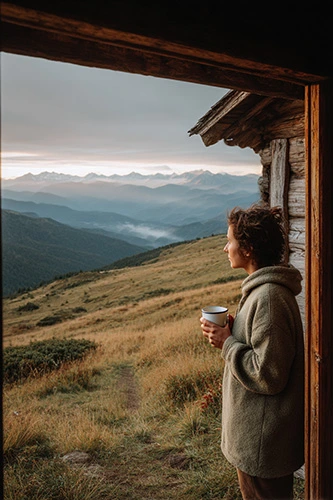
A person standing outside a simple mountain cabin, holding a cup with both hands, looking out toward a vast horizon of mountains. Early morning or late afternoon light. Calm atmosphere, no movement, no technology visible. The cabin is modest and blends into the landscape.
🔊 Listen & Practice This Card — 🎧 Finding Home in the Unknown Practice shadowing: read while listening and repeat. Then write down a few expressions or sentences that stood out to you.
Speed:
0:00 / 0:00
Ready to play

🏠 Finding Home in the Unknown

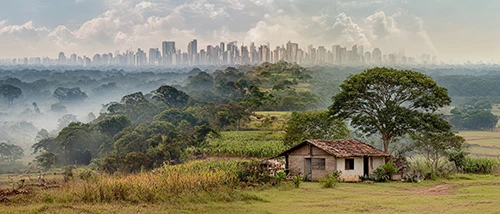
Horizontal landscape merging a city skyline on the left into forests and farmland, ending with a small house among trees on the right.

Off-grid living represents one of the most intentional choices a person can make. It means **walking away from** comfort and certainty to **take on** challenges that most people would rather avoid. It requires **giving up** conveniences we take for granted while **holding onto** the belief that a simpler life is worth the struggle. Those who choose this path don’t just **move away** from cities—they **move toward** something: a life where every resource is valued, every skill is earned, and every day brings direct contact with the natural world. They **trade in** financial security for a different kind of wealth—one measured in sunsets, homegrown meals, and the deep satisfaction of building something with their own hands.

In a world that keeps **speeding up**, off-grid living offers a radical alternative: the chance to **slow down**, **reconnect with** what matters, and discover that sometimes, the most abundant life is found in the simplest places.

🌿 Match the Phrasal Verbs - Off-Grid Living
0/15

Click one phrasal verb in Column A and its meaning in Column B. Complete all pairs.

Column A – Phrasal Verbs

Column B – Meanings

👥

Join Our Community!

Study the phrasal verbs on this page and then join our community with suggestions, comments, and learning

f Join the Community
0%
Scroll to Top