Phrasal Verbs • Level A2-B1

A HISTORY OF THE MORSE CODE

Phrasal Verbs Through Morse Code History

Human Communication Theme

Master Phrasal Verbs Through Morse Code History

1

A History of the Morse Code

Master phrasal verbs through Morse Code history

You are here
2

The Shrinking World

Learn phrasal verbs from Telegraph history

Start Learning
3

The Invisible Wire

Learn phrasal verbs from Radio Era

Start Learning

Multimedia Learning Hub

🎥 Listen, watch and practise English with immersive videos, podcasts and shadowing

🎭 Phrasal Verbs Video Practice

English Story Video for Phrasal Verbs Practice
🌟 Explore All Themes
Discover story-based lessons, videos and interactive practice

🎙️ Story Podcast for Phrasal Verbs

Story Podcast for English Communication
🎯 Open the Phrasal Verbs Dictionary
Review advanced phrasal verbs with examples, meaning and practice
🏆

Your Progress

0
Correct
0
Incorrect
0%
Accuracy
0
Score
00:00
Study Time

🔊 Listen & Practice This Card — When Silence Learned to Speak Practice shadowing: read while listening and repeat. Then write down a few expressions or sentences that stood out to you.
Speed:
0:00 / 0:00
Ready to play
illustration showing the evolution of communication centered around Morse code and electrical signaling
INTRO

When Silence Learned to Speak

For thousands of years, humans had to come up with creative ways to send messages across long distances. They used drums, smoke signals, and carrier pigeons — simple but powerful systems that allowed people to reach out to others far away. Each generation tried to build on what came before, always looking for faster and more reliable ways to communicate.

By the early 1800s, the world was changing fast. Cities were growing, trade was expanding, and people needed to get information across in minutes, not days. The old systems could no longer keep up with the demands of a modern society. Something completely new had to come along — and it was about to set off one of the greatest revolutions in human history.

That revolution came through electricity. Scientists and inventors began to figure out how electrical signals could stand for letters and numbers. Slowly, a new language of pulses and silences started to take shape — and the world would never go back to the way it was before. The age of instant communication was finally beginning to open up.

🔊 Listen & Practice This Card — A Grieving Man Who Changed Everything Practice shadowing: read while listening and repeat. Then write down a few expressions or sentences that stood out to you.
Speed:
0:00 / 0:00
Ready to play
Portrait of Samuel Morse and his telegraph invention
CARD

A Grieving Man Who Changed Everything

Samuel Morse did not set out to change the world. He was a painter, not a scientist. But in 1825, while he was away from home working on a portrait, his wife suddenly fell ill and died before he could get back to her. The news took days to reach him — and that painful experience made him think about how desperately people needed faster communication.

Morse decided to take on the challenge of creating an electrical telegraph. He worked with a scientist named Joseph Henry and put together a simple but brilliant system: electrical pulses sent through a wire could stand for letters of the alphabet. It took years of hard work to work out all the technical problems, but Morse never gave up.

On May 24, 1844, Morse was ready to show off his invention. He sent out the first official telegraph message — "What hath God wrought" — from Washington D.C. to Baltimore. That moment would go down in history as the beginning of a new era. A grieving man had come up with a system that would connect millions of people across the world.

🔊 Listen & Practice This Card — Dots, Dashes and the Logic of Silence Practice shadowing: read while listening and repeat. Then write down a few expressions or sentences that stood out to you.
Speed:
0:00 / 0:00
Ready to play
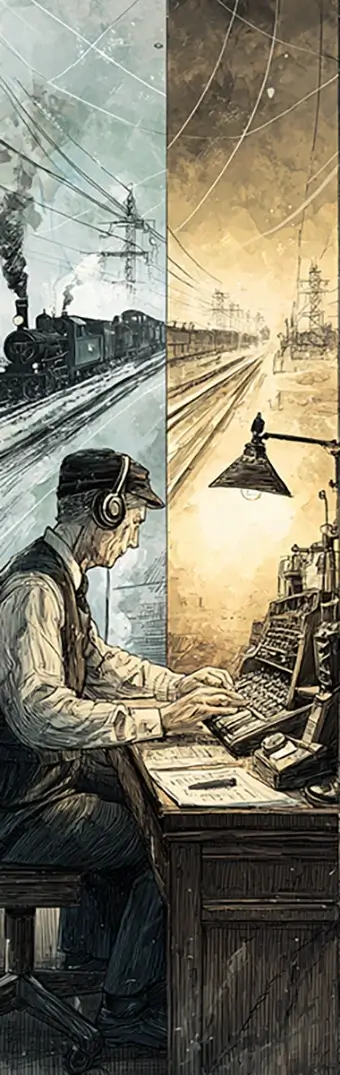
Morse Code in action as a revolutionary communication system. In the foreground, a skilled 19th-century telegraph operator sits at a wooden desk
CARD

Dots, Dashes and the Logic of Silence

The Morse Code system is surprisingly simple once you break it down. Every letter of the alphabet and every number is made up of a combination of short signals — called dots — and long signals — called dashes. The letter "E", for example, stands for just one dot, while "S" is three dots. Together, these elements make up a complete communication system that anyone could learn.

Telegraph operators had to pick up the code through hours of daily practice. Beginners would start out slowly, tapping simple words until their fingers caught on naturally. The best operators could keep up with speeds of over 20 words per minute, tapping out messages with extraordinary precision. It was a skill that took time to build up, but once learned, it never really went away.

The real genius of Morse Code was how much it could cut down the time needed to get a message through. A letter that used to take a week could now get across the country in seconds. Businesses, governments, and newspapers all took advantage of this new speed. The telegraph truly sped up the pace of modern life in ways that people had never imagined before.

🔊 Listen & Practice This Card — SOS: When Dots and Dashes Saved Lives Practice shadowing: read while listening and repeat. Then write down a few expressions or sentences that stood out to you.
Speed:
0:00 / 0:00
Ready to play
Historical image of telegraph operators and the Titanic SOS signal
CARD

SOS: When Dots and Dashes Saved Lives

During the American Civil War, the telegraph took on a vital role in military strategy. Generals could pass on orders to troops miles away almost instantly. Commanders carried out complex battle plans that would have been impossible without real-time communication. For the first time in history, a war was being fought with information moving as fast as decisions could be made.

But perhaps the most dramatic moment came on the night of April 14, 1912. As the Titanic began to go down, radio operators put out a desperate distress signal using Morse Code — three dots, three dashes, three dots: S-O-S. The nearby ship Carpathia picked up the signal and immediately set off to help. Over 700 people were saved because an operator knew how to hold on and keep transmitting until help arrived.

Looking back, it is remarkable how much one simple code gave rise to. Morse Code opened up global communication, connected continents, and laid the groundwork for every communication technology that came after it. Even today, its influence lives on in the binary language of computers — ones and zeros that, in a way, carry on the spirit of dots and dashes first imagined by a heartbroken painter in the 1830s.

🔊 Listen & Practice This Card — The Signal That Never Went Silent Practice shadowing: read while listening and repeat. Then write down a few expressions or sentences that stood out to you.
Speed:
0:00 / 0:00
Ready to play
Illustration representing the lasting legacy of Morse Code in modern communication
CONCLUSION

The Signal That Never Went Silent

Morse Code did far more than speed up the delivery of messages — it completely changed the way humans related to time and distance. For the first time, people could reach out across vast spaces in real time. Communities that had always felt far apart could suddenly connect with each other in seconds, and the world began to feel much smaller.

The telegraph paved the way for everything that came next. Telephone, radio, television, the internet — all of these technologies build on the foundations that Morse and his contemporaries put in place. One idea led to another, and each innovation gave way to something even more powerful. The signal that Morse sent out in 1844 never really stopped traveling.

As we move on to the next chapter of this journey — the age of the telephone and radio — it is worth looking back at what this era truly meant. Humanity had always found ways to bridge the gap between people separated by distance. But with Morse Code, for the very first time, the gap almost disappeared. And the world has been catching up with that idea ever since.

Complete the Gaps — Morse Code & Communication (Phrasal Verbs)

Tap the blanks and choose the correct option.

Question 1:
Telegraph operators had to _________ the code through hours of daily practice, slowly _________ the rhythm of dots and dashes.
Question 2:
Samuel Morse did not _________ to change the world — he was a painter, not a scientist.
Question 3:
The old systems could no longer _________ the demands of a modern society.
Question 4:
Scientists began to _________ how electrical signals could _________ letters and numbers.
Question 5:
Each generation tried to _________ what came before, always looking for faster ways to communicate.
Question 6:
As we _________ to the next chapter, it is worth _________ at what this era truly meant for humanity.
Question 7:
For thousands of years, humans had to _________ creative ways to send messages across long distances.
Question 8:
Something new had to come along — and it was about to _________ one of the greatest revolutions in human history.
Question 9:
The telegraph _________ for everything that came next — telephone, radio, television, the internet.
Question 10:
Morse decided to _________ the challenge and _________ a simple but brilliant system using electrical pulses.
Question 11:
As the Titanic began to go down, operators _________ an SOS signal that was _________ by a nearby ship.
Question 12:
Morse Code could _________ the time needed to _________ a message across the country — from days to seconds.
Score: 0/12 questions correct (0%)
Alessandra Fernandes Nóbrega
History teacher and educational content creator. M.A. in History of Education (UFPB). Creator of WeeklyCross, FlipVerbs and Flowglish — a connected ecosystem for learning English through context, not memorisation. Trained in educational entrepreneurship in Finland.

WeeklyCross teaches phrasal verbs through historical and cultural context. Each lesson connects to vocabulary practice on FlipVerbs and fluency levels on Flowglish — forming a complete learning ecosystem.

0%
Scroll to Top