Phrasal Verbs • Level A2-B1

The Shrinking World

Phrasal Verbs Through Telegraph History

Human Communication Theme

Master Phrasal Verbs Through Telegraph History

1

A History of the Morse Code

Master phrasal verbs through Morse Code history

Start Learning
2

The Shrinking World

Learn phrasal verbs from Telegraph history

You are here
3

The Invisible Wire

Learn phrasal verbs from Radio Era

Start Learning

Multimedia Learning Hub

🎥 Listen, watch and practise English with immersive videos, podcasts and shadowing

🎭 Phrasal Verbs Video Practice

English Story Video for Phrasal Verbs Practice
🌟 Explore All Themes
Discover story-based lessons, videos and interactive practice

🎙️ Story Podcast for Phrasal Verbs

Story Podcast for English Communication
🎯 Open the Phrasal Verbs Dictionary
Review advanced phrasal verbs with examples, meaning and practice
🏆

Your Progress

0
Correct
0
Incorrect
0%
Accuracy
0
Score
00:00
Study Time

🔊 Listen & Practice This Card — When the World Suddenly Got Smaller Practice shadowing: read while listening and repeat. Then write down a few expressions or sentences that stood out to you.
Speed:
0:00 / 0:00
Ready to play
illustration showing the birth of Morse code and the beginning of electric communication
INTRO

When the World Suddenly Got Smaller

Samuel Morse had already cracked the code — literally. The system of dots and dashes he came up with gave humans a way to break down language into electrical pulses. But a code without a machine to carry it is just an idea sitting on paper. The telegraph was the missing piece: the physical infrastructure that could take those pulses and send them out across hundreds of miles of copper wire in seconds. Think of it this way — Morse built the language, and the telegraph built the road.

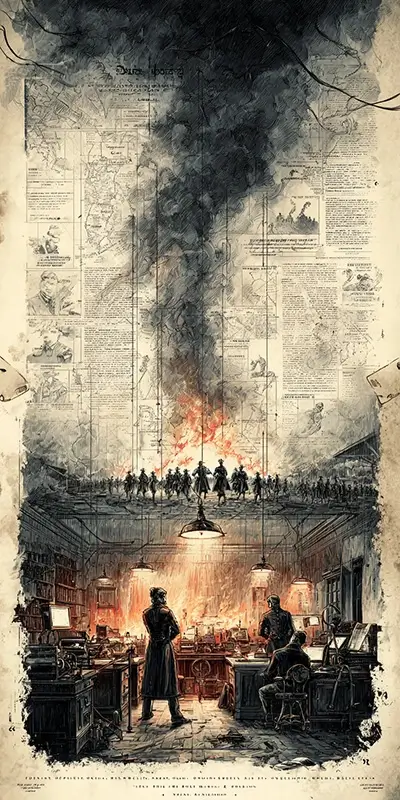
Before the telegraph came along, news traveled at the speed of a horse. A battle fought in Europe could take weeks to show up in an American newspaper. Stock prices in London had no way of getting through to traders in New York before fortunes were already lost or made. The world was vast, slow, and stubbornly disconnected — and most people had simply accepted that this was just the way things were. Then the telegraph showed up and made everyone rethink everything.

What followed wasn't simply a faster postal service. The telegraph brought about a shift so deep that people at the time struggled to find words for it. Businesses had to build up entirely new ways of operating. Governments had to work out new strategies for controlling information. Journalists had to throw out everything they knew about deadlines. The wire didn't just speed up the world — it turned it inside out, and nobody was quite ready for what came next.
🔊 Listen & Practice This Card — Buying, Selling and the Speed of Electricity Practice shadowing: read while listening and repeat. Then write down a few expressions or sentences that stood out to you.
Speed:
0:00 / 0:00
Ready to play
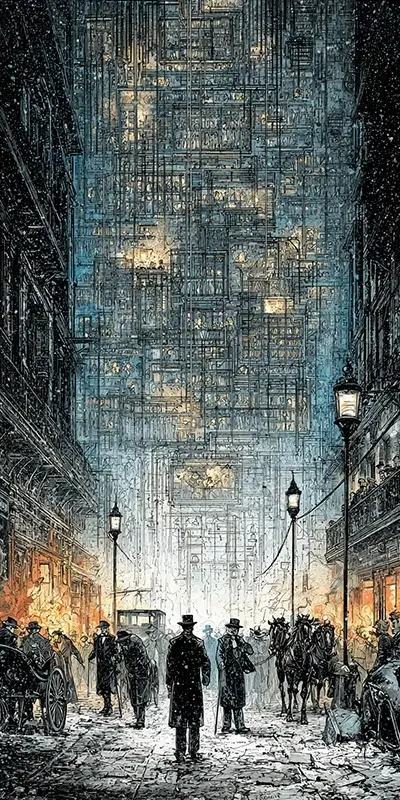
illustration of the telegraph revolutionizing finance in the 1800s
DEVELOPMENT

Buying, Selling and the Speed of Electricity

The financial world was one of the first to catch on to what the telegraph could really do. Before the wires went up, merchants had to send out agents on horseback to gather prices from distant markets — and by the time that information came back, it had already gone stale. The telegraph changed all that. Brokers could now find out current prices in real time, opening up possibilities that nobody had seriously thought about before. It was a little like giving a chess player the ability to see their opponent's hand.

Banks and trading houses quickly set up direct telegraph connections to other financial centers. The ability to carry out transactions across hundreds of miles in seconds gave rise to modern financial markets as we know them. Those who figured out how to use the telegraph faster than their rivals could stay comfortably ahead of the game. Those who failed to keep up found themselves left behind in a world that had moved on without stopping to wait for them.

Of course, where there is speed and money, there is also trouble. Clever operators soon learned to hold back information or pass on false data to push prices in the direction they wanted. Fraud became harder to pin down and easier to carry out at a distance. Regulators struggled to keep up with an economy that was suddenly moving faster than any law had been written to handle. The same wire that opened up so much opportunity also opened up entirely new ways to take advantage of it. Some things, it turns out, never really change.

🔊 Listen & Practice This Card — War, Power and the Politics of the Wire Practice shadowing: read while listening and repeat. Then write down a few expressions or sentences that stood out to you.
Speed:
0:00 / 0:00
Ready to play
illustration of the telegraph revolutionizing war and information during the American Civil War
DEVELOPMENT

War, Power and the Politics of the Wire

A single decision made too late can throw away everything an army has fought for. Battles are not just won by the soldiers moving across the field — they are won or lost by the information flowing between those who can see the full picture and those who are standing in the middle of the chaos. Commanders have always known this. But knowing something and being able to act on it are two very different things. For centuries, the best tool available was a rider on a fast horse. The telegraph changed that reality so dramatically that wars would never be fought — or even thought about — in the same way again.

Abraham Lincoln understood this before most of his generals did. He would show up at the War Department telegraph office late at night, sometimes still in his coat and hat, waiting for dispatches to come through from the front. For the first time in history, a president could reach out directly to a battlefield commander hundreds of miles away, find out what was happening, and pass on new orders — all within minutes. Lincoln didn't just use the telegraph as a tool. He built up an entirely new way of running a war around it, staying ahead of events instead of always finding out about them too late.

But controlling the telegraph also meant controlling the story. Governments on both sides quickly moved to take over strategic lines, cutting off enemy communications and making sure only their version of events got through to the public. The wire had handed enormous power to whoever could hold on to it — and everyone knew it. Wars were no longer just fought on the battlefield. They were fought along every mile of copper cable connecting the capital to the front, and the side that could keep those lines up and running held an advantage that no amount of extra soldiers could easily make up for.

🔊 Listen & Practice This Card — The Cable That Tied Two Worlds Together Practice shadowing: read while listening and repeat. Then write down a few expressions or sentences that stood out to you.
Speed:
0:00 / 0:00
Ready to play
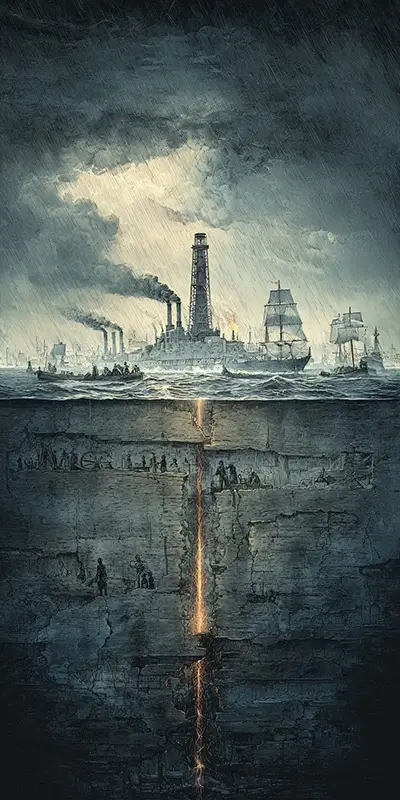
illustration of the first transatlantic telegraph cable connecting Europe and America in the 19th century
DEVELOPMENT

The Cable That Tied Two Worlds Together

For all its power on land, the telegraph still ran up against one enormous obstacle: the Atlantic Ocean. Europe and America were growing closer in every sense — but a message still had to be put on a ship and carried across thousands of miles of open water. The idea of laying a telegraph cable across the ocean floor seemed so far-fetched that most people laughed it off — but a determined businessman named Cyrus Field simply refused to give up.

Field set out in 1854 to pull off what most people considered impossible. Two attempts broke down at sea before a third cable finally went live in August 1858. Queen Victoria and President Buchanan exchanged messages, and the world erupted in celebration. But the cable gave out after just three weeks — which was, to put it mildly, a bit embarrassing. It took another eight years of setbacks and stubborn refinements before a reliable transatlantic cable finally came through in 1866 and permanently linked up the two continents.

The impact was immediate and genuinely staggering. Cotton prices in Liverpool were now tied directly to harvests in Georgia. Political crises could be sorted out through direct diplomatic exchanges rather than weeks of delayed correspondence. Shipping companies could track down vessels and reroute them mid-voyage. What had once taken the better part of a month to pass on across the ocean could now get through in minutes. Two worlds had been pulled together by nothing more than a thread of copper lying quietly on the bottom of the sea.

🔊 Listen & Practice This Card — The Wire That the World Built On Practice shadowing: read while listening and repeat. Then write down a few expressions or sentences that stood out to you.
Speed:
0:00 / 0:00
Ready to play
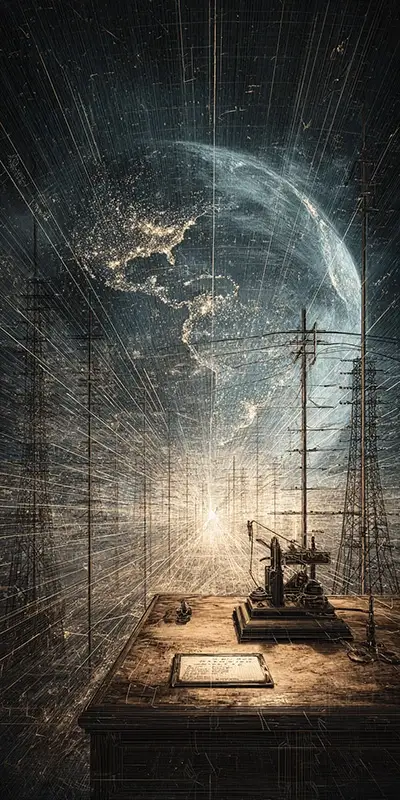
illustration showing the evolution of global communication beginning with the electric telegraph
CONCLUSION

The Wire That the World Built On

The telegraph held on as the dominant form of long-distance communication for over half a century — which, for a technology, is actually a pretty impressive run. But by the early twentieth century, new technologies were catching up fast. The telephone allowed voices to come through where once only dots and dashes had traveled. Radio was opening up communication that didn't depend on any wire at all. The telegraph began to give way, slowly at first and then quite suddenly, to a world it had quietly helped to build.

Yet everything the telephone, radio, and eventually the internet would go on to do had already been laid out in principle by the telegraph. The idea that information could be broken down into a code, sent out as an electrical signal, and reassembled perfectly at the other end — that fundamental logic never went away. Engineers building the first telephone networks could build on existing telegraph infrastructure. The transatlantic cable routes that Cyrus Field had opened up became the direct ancestors of the fiber-optic corridors carrying internet traffic today. The telegraph didn't just pave the way — it was the way.

What the telegraph stands out for, more than anything else, is the proof it gave us that the world could be shrunk through human stubbornness and ingenuity. Every time we reach out across a distance that would once have seemed unbridgeable — every message that gets through in an instant to someone on the other side of the planet — we are building on something that a painter from Connecticut and a roll of copper wire once quietly set in motion. The world got smaller. And it never went back.

Match the Telegraph Phrasal Verbs
0/16

Click one item in Column A and its meaning in Column B. Complete all pairs.

Column A – Phrasal Verbs

Column B – Meanings

Alessandra Fernandes Nóbrega
History teacher and educational content creator. M.A. in History of Education (UFPB). Creator of WeeklyCross, FlipVerbs and Flowglish — a connected ecosystem for learning English through context, not memorisation. Trained in educational entrepreneurship in Finland.

WeeklyCross teaches phrasal verbs through historical and cultural context. Each lesson connects to vocabulary practice on FlipVerbs and fluency levels on Flowglish — forming a complete learning ecosystem.

0%
Scroll to Top