Phrasal Verbs in Context
Tiny House Hub

Big questions, tiny answers


Tiny House Hub:

Urban Compact Living

Learn phrasal verbs to talk about small space living in urban environments

Level: Upper-Intermediate to Advanced (B2-C1)


Phrasal Verbs in Context: Urban Compact Living
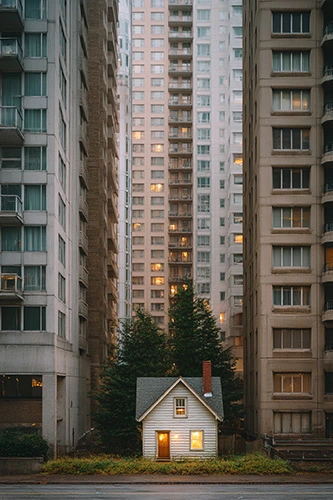
A small, simple house standing between two tall modern apartment buildings, representing the contrast between compact living and urban expansion

Welcome to Urban Compact Living, a lesson where we explore one of the most significant cultural shifts of our time: the move toward smaller, smarter living spaces in modern cities. The change didn't happen overnight. Slowly, people began rethinking what "home" really means. Living closer to the city center to cut down on commuting time. Spending less money on mortgages to free up resources for experiences.

Staying connected to services, culture, and opportunities right around the corner. These practical reasons started pulling people away from the suburban dream of bigger houses and bigger lawns. But the shift went deeper than economics. Philosophical questions began filtering through everyday choices: To what extent do objects matter more than experiences? Which possessions truly add value to our livesβ€”and which ones just take up space?

These reflections, combined with new social and economic demandsβ€”longer working hours, remote jobs, changing family structuresβ€”have pushed us to rethink our lifestyles. And those lifestyles have become increasingly flexible. In this lesson, you'll read about how compact apartments, lofts, and social housing transformed urban living. You'll discover how architects and designers opened up small spaces with smart solutions, and how millions of people learned to get by with lessβ€”without giving up comfort or quality of life.

Multimedia Learning Hub

πŸŽ₯ Listen, watch and practise English with immersive videos, podcasts and shadowing

🎭 Phrasal Verbs Video Practice

English Story Video for Phrasal Verbs Practice
🌟 Explore All Themes
Discover story-based lessons, videos and interactive practice

πŸŽ™οΈ Story Podcast for Phrasal Verbs

Story Podcast for English Communication
🎯 Open the Phrasal Verbs Dictionary
Review advanced phrasal verbs with examples, meaning and practice
πŸ†

Your Progress

0
Correct
0
Incorrect
0%
Accuracy
0
Score
00:00
Study Time

πŸ”Š Listen & Practice This Card β€” 🎧Embracing Small: A Cultural Revolution in Values Practice shadowing: read while listening and repeat. Then write down a few expressions or sentences that stood out to you.
Speed:
0:00 / 0:00
Ready to play

🏠 Embracing Small: A Cultural Revolution in Values

A serious and sad seller or agent receives payment with a reserved expression, while the buyer appears confident and composed, fully aware of their choice. Soft afternoon light, subtle shadows, realistic urban setting

The shift toward smaller living spaces reflected something deeper than economicsβ€”it represented people breaking down the old equation of size equals success. Throughout the postwar boom, families had been buying into the idea that a large home was proof you had made it. But by the 1980s, a new generation was pulling away from this narrative. Young professionals were drawing on existentialist philosophy that had been filtering through universities since the 1960s: your identity doesn’t come from what you own; it emerges from how you live. This intellectual current began to show up in everyday decisions about housing, as people started to work out what really mattered to them beyond square footage.

The minimalist aesthetic that would later take over design magazines actually grew out of this philosophical shift. People weren’t just throwing out excess possessions to follow a trendβ€”they were clearing out physical and mental clutter to make room for what genuinely brought meaning to their lives. In small apartments, you couldn’t hold onto everything; you had to pick out what was essential and let go of the rest. This forced curation became a practice in intentionality. The constraint of small living turned out to be liberating rather than limiting, opening up a new way of thinking about home as a carefully curated refuge rather than a storage facility.

Choosing a smaller home also meant opting out of the maintenance treadmill. People were fed up with spending weekends fixing up large houses they barely had time to enjoy. The emerging cultural shift called for homes that fit into busy lives rather than taking over them. Young professionals wanted to get out and experience their cities, not be tied down to endless home projects. This mindset set apart the new generation: home was becoming a base camp for living, not the destination itself.

The small apartment meant you could keep up with maintenance easily, free up weekends for other pursuits, and move on when opportunities arose. What seemed like giving up space was actually gaining freedom.

πŸ”Š Listen & Practice This Card β€” 🎧 Government Housing Meets the New Mindset Practice shadowing: read while listening and repeat. Then write down a few expressions or sentences that stood out to you.
Speed:
0:00 / 0:00
Ready to play

🏠 Government Housing Meets the New Mindset

A row of identical apartment buildings stretching into the distance. The repetition emphasizes uniformity and system-driven housing. In the foreground, a confident buyer hands over payment to a serious figure. The buyer stands relaxed and self-assured, contrasting with the rigid environment.

As the middle class continued to thin out economically through the 1980s and 90s, government housing programs had to adapt to a new reality. The massive tower blocks that had been thrown up in the 1960s weren’t working out as planned, and budgets were drying up. But this constraint turned into an opportunity. Architects began to look into European models that had taken off successfullyβ€”compact apartments that made up for smaller size with intelligent layouts. Instead of trying to squeeze in as many units as possible, new projects focused on creating homes that families could actually settle into comfortably.

These developments drew on the emerging cultural acceptance of compact living. Designers worked on floor plans that could open up through smart furniture, building in storage solutions previous generations would never have thought of. The goal was to do away with wasted space while holding onto livability. When families moved in, many were surprised they could get by with 650 square feet if every inch was thoughtfully designed. Kitchen counters that folded down, beds that pulled out from walls, living rooms that could turn into dining areasβ€”these innovations helped people make do with less space without feeling cramped.

What set these projects apart was community integration. Planners learned they couldn’t cut residents off from the wider city or leave them out of decisions. Successful developments tied into existing neighborhoods, reaching out to local businesses and transit. They set up shared amenities that helped residents come together and look after each other. When projects fell through, developers had usually skimped on maintenance or shut out resident input.

But when done right, these communities held up remarkably well, proving government housing could measure up to private developments if quality commitment carried through from design to maintenance.

πŸ”Š Listen & Practice This Card β€” 🎧 Curating Life in Small Spaces: Less Room, More Intention Practice shadowing: read while listening and repeat. Then write down a few expressions or sentences that stood out to you.
Speed:
0:00 / 0:00
Ready to play

🏠 Curating Life in Small Spaces: Less Room, More Intention

Living in a small apartment forced people to take on the role of curator in their own lives. Every object that came into the space had to earn its place. This wasn’t about doing without things you lovedβ€”it was about sorting through possessions and picking out what truly mattered. The practice caught on among young professionals who found liberation in letting go of inherited furniture they’d been holding onto out of obligation, collections they’d built up but never enjoyed, and gadgets they’d picked up on impulse. The constraint of space became a tool for working out what was essential versus what was just taking up roomβ€”both physical and mental.

This curation extended beyond objects to how people set up their entire lives. Small spaces ruled out certain activities but opened up others. You couldn’t fill up your apartment with a home gym or extensive library, so you turned to community resources: public gyms, maker spaces, libraries. This shift brought about a surprising benefit: people began to get out more, engage with their communities, and run into neighbors in shared spaces. The small apartment was a home base designed to wind down after days spent out and about.

Residents cut down on time spent cleaning up, freeing up hours for hobbies, socializing, or simply relaxing. For many, choosing to live in a small apartment became tied to larger life projects that reached beyond the home itself. Artists could rent out workspace elsewhere. Writers could carry out their work in cafes. Activists could throw themselves into community organizing rather than settling down with mortgages that would tie them down to one location.

The small space meant less financial pressure, which opened up possibilities to take up meaningful work, to move around when opportunities arose, or to set aside savings for experiences. What looked like scaling back on living space was actually making room for a different kind of wealth: time, flexibility, and the freedom to follow through on dreams that couldn’t fit into conventional suburban life.

A young adult stands near a window overlooking a dense city, while subtle visual cues suggest the past: vintage furniture details from the 1980s, books, analog objects, warm tones. Outside the window, modern tiny houses and micro-apartments appear in the distance, blending past and present.
πŸ”Š Listen & Practice This Card β€” 🎧 A New Definition of Home: From Possession to Experience Practice shadowing: read while listening and repeat. Then write down a few expressions or sentences that stood out to you.
Speed:
0:00 / 0:00
Ready to play

🏠 A New Definition of Home: From Possession to Experience

The compact living revolution that took shape in the 1980s and 90s represented more than just a response to economic pressuresβ€”it brought forth a fundamental reimagining of what home meant in modern life. The generation that came of age during this period had broken free from the post-war assumption that happiness came down to square footage and property ownership. They’d worked through the cultural inheritance that tied identity to possessions and come out with different values. This shift built up gradually as people tried out smaller spaces, found out they could be happy there, and began to spread the word. What had seemed like settling for less turned out to be choosing moreβ€”more freedom, more intention, more focus on what actually made up a meaningful life.

The lessons from this era would carry over into the 21st century’s tiny house movement, but with an important evolution: what started as economic necessity gave way to conscious lifestyle choice. People began to seek out small homes not because they were shut out of larger ones, but because they’d woken up to the benefits of living with less. The cultural shift that set in during the crisis years had taken root, creating a foundation that later generations would build on. The minimalist philosophy that had been floating around intellectual circles finally filtered down into mainstream culture, backed up by decades of people who had lived through the compact apartment era and could point to real-life benefits rather than abstract theories. Today, when young people move into tiny houses or micro-apartments, they’re drawing on this rich cultural history even if they don’t realize it.

The path was laid out by the generation that faced down economic crisis and came up with a new way of thinking about home. These pioneers proved you could get by in small spaces, do away with excess without missing out on quality of life, and actually come out ahead by trading in square footage for freedom. Their legacy isn’t just the compact housing stock they left behindβ€”it’s the cultural permission they passed on to question whether bigger is actually better. They paved the way for understanding home not as a container for possessions, but as a carefully chosen space that fits into the life you want to live out, one that supports your dreams rather than weighing you down with obligations that eat into the time and resources you could devote to what truly matters.

Urban Compact Living - Phrasal Verbs Exercise

Click on the blanks to choose the correct phrasal verb

Question 1:
People weren't just _________ excess possessions to follow a trend.
Question 2:
By the 1980s, a new generation was _________ this narrative about big houses.
Question 3:
What started as economic necessity _________ conscious lifestyle choice.
Question 4:
The small space meant less financial pressure, which _________ possibilities for meaningful work.
Question 5:
Throughout the postwar boom, families had been _________ the idea that a large home was proof of success.
Question 6:
Government budgets were _________ and programs had to adapt.
Question 7:
This shift _________ a surprising benefit: people began to get out more.
Question 8:
The shift toward smaller living spaces reflected people _________ the old equation of size equals success.
Question 9:
People were _________ spending weekends fixing up large houses.
Question 10:
Families were surprised they could _________ 650 square feet if every inch was designed well.
Question 11:
The massive tower blocks that had been _________ in the 1960s weren't working out.
Question 12:
They were _________ physical and mental clutter to make room for meaning.
Score: 0/12 questions correct (0%)
πŸ‘₯

Join Our Community!

Study the phrasal verbs on this page and then join our community with suggestions, comments, and learning

f Join the Community
0%
Scroll to Top