Phrasal Verbs • Level A2-B1

The World Becomes a Web

Phrasal Verbs Through the Social Media Revolution

Human Communication Theme

Master Phrasal Verbs Through the Age of Connection

1

The World in Your Pocket

Learn phrasal verbs from Smartphone history

Start Learning
2

The World Becomes a Web

Learn phrasal verbs Through the Age of Connection

You are here
3

The Global Village

Learn phrasal verbs from Computers Hitory

Start Learning

Multimedia Learning Hub

🎥 Listen, watch and practise English with immersive videos, podcasts and shadowing

🎭 Phrasal Verbs Video Practice

English Story Video for Phrasal Verbs Practice
🌟 Explore All Themes
Discover story-based lessons, videos and interactive practice

🎙️ Story Podcast for Phrasal Verbs

Story Podcast for English Communication
🎯 Open the Phrasal Verbs Dictionary
Review advanced phrasal verbs with examples, meaning and practice
🏆

Your Progress

0
Correct
0
Incorrect
0%
Accuracy
0
Score
00:00
Study Time

🔊 Listen & Practice This Card — When Silence Learned to Speak Practice shadowing: read while listening and repeat. Then write down a few expressions or sentences that stood out to you.
Speed:
0:00 / 0:00
Ready to play
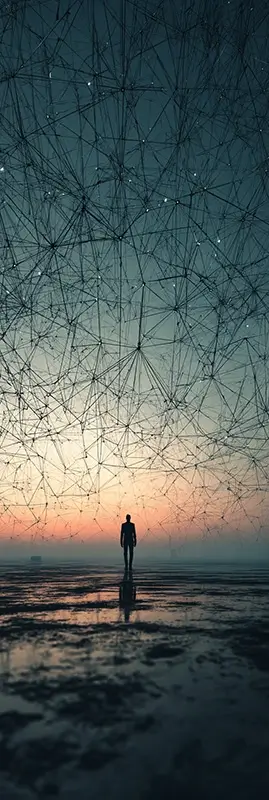
a single person standing in a quiet open space at dusk, symbolizing isolation, soft natural lighting, minimal environment, gradually surrounded by glowing digital connections forming a vast network
INTRODUCTION

The World Becomes a Web

For most of human history, your world was roughly the size of your reach. You knew the people you could walk to, passed news along to whoever was nearby, and relied on physical presence to keep relationships alive. Even after the telephone came along, the circle stayed manageable — one voice at a time, one conversation that ended when you hung up.

Then, in the early 2000s, platforms started showing up that did something entirely new. They didn't just pass your message on from one point to another — they put you, your thoughts, your photos, your opinions, into a shared space where anyone could tune in, follow you, and talk back. The audience was no longer a crowd in a square. It was everyone, all at once.

The web that had once linked up computers now began linking up lives. Connections that would have faded out with distance instead carried on in a new, borderless form. And the world, for better and for worse, would never quite fit back into its old size again.
🔊 Listen & Practice This Card — Buying, Selling and the Speed of Electricity Practice shadowing: read while listening and repeat. Then write down a few expressions or sentences that stood out to you.
Speed:
0:00 / 0:00
Ready to play
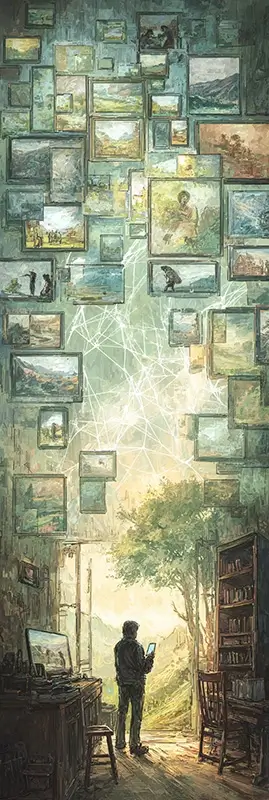
a person in a small-town home using a smartphone, surrounded by floating windows of global knowledge and human connection
CARD 2

From the Street to the Feed

Before social media, relationships fell into neat categories: family, colleagues, old friends you had drifted away from, neighbours you waved to. Keeping up with someone required real effort — a visit, a phone call, a letter. Friendships that didn't get that effort slowly faded out, and everyone accepted that as natural.

Social media changed the rules of maintenance. Suddenly you could check in on someone across the world with a single tap. People you had lost touch with for twenty years started showing up in your feed, and relationships that would have died off instead carried on in a low-intensity, always-available form. You weren't exactly close. But you weren't strangers either.

At the same time, entirely new kinds of connection started coming together around shared knowledge and curiosity. People who had grown up in small towns or isolated communities could suddenly reach out to historians, scientists, artists and craftspeople from across the world — and take in perspectives and practices that their local environment could never have offered up. A farmer in the northeast of Brazil could link up with permaculture communities in Portugal. A self-taught musician could tap into a living tradition on the other side of the planet. The limits of what you could learn from and be shaped by were no longer drawn by the street you lived on.

🔊 Listen & Practice This Card — War, Power and the Politics of the Wire Practice shadowing: read while listening and repeat. Then write down a few expressions or sentences that stood out to you.
Speed:
0:00 / 0:00
Ready to play
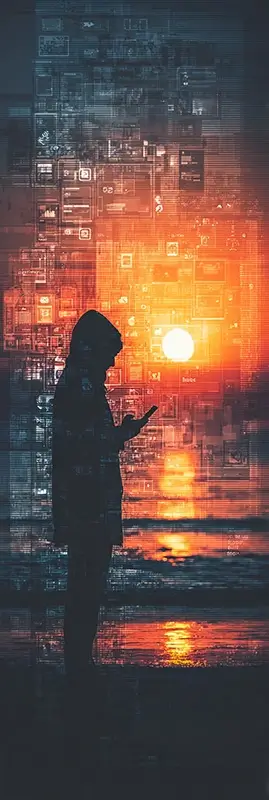
a person standing before a beautiful sunset but looking only at their smartphone, the natural world fading into the background while glowing social media notifications, icons, scrolling interface elements and digital light
CARD 3

When the Screen Moves In

There's a moment many people can pinpoint — not a date, but a feeling. The moment when the phone stopped being something you picked up and became something you never put down. When a sunset became less about watching it and more about capturing it to share it. When you checked in online before you had even woken up properly.

The virtual hadn't just expanded the real. It had started crowding it out. Social media was designed to hold on to your attention, and it turned out to be extraordinarily good at it. Notifications pulled you back. Scroll mechanics were set up to keep you going. The reward of a like or a comment triggered something close enough to human approval that the brain had a hard time sorting it out from the real thing.

People found themselves logging on not because they wanted to, but because the absence felt uncomfortable. The connection had turned into a compulsion. This wasn't a personal failing — it was an architectural one. The platforms had been built to max out engagement, and engagement meant your time, taken up in seconds and sold off to advertisers. The web had become a place you couldn't easily step away from, even when you wanted to.

🔊 Listen & Practice This Card — The Cable That Tied Two Worlds Together Practice shadowing: read while listening and repeat. Then write down a few expressions or sentences that stood out to you.
Speed:
0:00 / 0:00
Ready to play
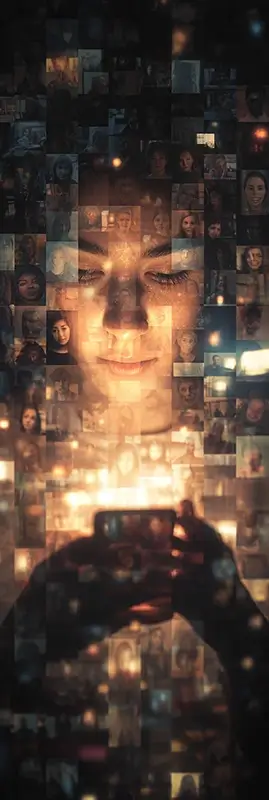
a person holding a phone, deeply emotional expression, illuminated by soft screen light, while dozens of semi-transparent human faces
CARD 4

Is Virtual Less Real?

When someone loses a loved one and strangers from three continents reach out with genuine grief — is that less real because it happened on a screen? When activists come together across borders and bring about change that no single government could have held back — does it count for less because it was carried out through a feed?

The question of whether virtual connections are really real runs into a simple problem: they clearly work on real people. They bring out real emotions — joy, loneliness, solidarity, shame. They shape real decisions and have set off real revolutions. The idea that something happening through a screen is automatically less meaningful is a habit of thought that the telephone should have done away with a century ago, but apparently never quite sank in.

What social media did change was scale and speed. Human beings grew up to handle the social complexity of a few dozen close relationships. Now we were being asked to keep up with thousands of weak ties, public performances, and real-time global events — all piling up at once, all competing for the same emotional bandwidth. The virtual wasn't fake. It was just more than we knew how to take in.

🔊 Listen & Practice This Card — The Wire That the World Built On Practice shadowing: read while listening and repeat. Then write down a few expressions or sentences that stood out to you.
Speed:
0:00 / 0:00
Ready to play
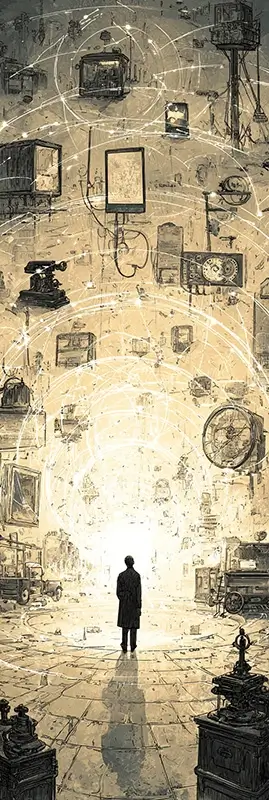
a person standing at the center while different eras of communication unfold around them in a circular timeline: ancient drums, messenger pigeons, printing press, telegraph wires, vintage telephone, and modern smartphones
CONCLUSION

Still Human, Still Reaching

Every communication technology in this hub — the drum, the pigeon, the printing press, the telegraph, the telephone — was met with some version of the same anxiety: that it would change human connection beyond recognition, that something essential would die out, and that we would lose the ability to truly reach out to each other.

And every time, that anxiety turned out to be both right and wrong. Right, because things did change. Ways of relating that seemed permanent faded out. New habits grew up that previous generations would have struggled to make sense of. Social media was no different — it reshaped expectations, attention spans, and the very meaning of words like friend and community.

Wrong, because the impulse underneath never went away. The same need that drove someone in 1844 to tap out a message in Morse code — the stubborn, beautiful human refusal to let distance stand in the way — is still what drives someone today to reach out to a stranger across the world. The tools move on. The longing doesn't. And the web that linked up lives around the world was only setting up something bigger still — a global community still figuring out what it truly means to belong. But that — that's Trail 6.

Match the Social Media Phrasal Verbs
0/16

Click one item in Column A and its meaning in Column B. Complete all pairs.

Column A – Phrasal Verbs

Column B – Meanings

Alessandra Fernandes Nóbrega
History teacher and educational content creator. M.A. in History of Education (UFPB). Creator of WeeklyCross, FlipVerbs and Flowglish — a connected ecosystem for learning English through context, not memorisation. Trained in educational entrepreneurship in Finland.

WeeklyCross teaches phrasal verbs through historical and cultural context. Each lesson connects to vocabulary practice on FlipVerbs and fluency levels on Flowglish — forming a complete learning ecosystem.

0%
Scroll to Top