Phrasal Verbs • Level A2-B1

THE INVISIBLE WIRE

Phrasal Verbs Through Radio History

Human Communication Theme

Master Phrasal Verbs Through Radio Era

1

A History of the Morse Code

Master phrasal verbs through Morse Code history

Start Learning
2

The Shrinking World

Learn phrasal verbs from Telegraph history

Start Learning
3

The Invisible Wire

Learn phrasal verbs from Radio Era

You are here

Multimedia Learning Hub

🎥 Listen, watch and practise English with immersive videos, podcasts and shadowing

🎭 Phrasal Verbs Video Practice

English Story Video for Phrasal Verbs Practice
🌟 Explore All Themes
Discover story-based lessons, videos and interactive practice

🎙️ Story Podcast for Phrasal Verbs

Story Podcast for English Communication
🎯 Open the Phrasal Verbs Dictionary
Review advanced phrasal verbs with examples, meaning and practice
🏆

Your Progress

0
Correct
0
Incorrect
0%
Accuracy
0
Score
00:00
Study Time

🔊 Listen & Practice This Card — When a Voice Fell Out of Thin Air Practice shadowing: read while listening and repeat. Then write down a few expressions or sentences that stood out to you.
Speed:
0:00 / 0:00
Ready to play
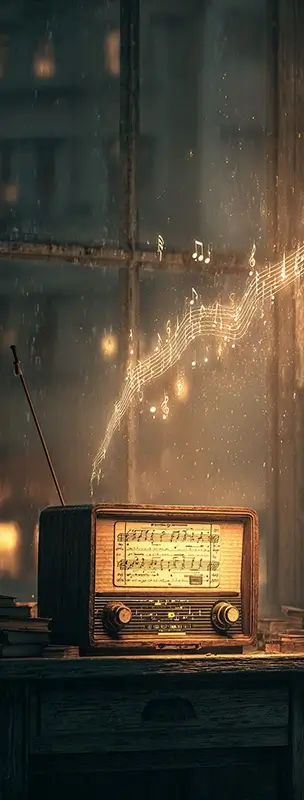
an old radio sits on an antique wooden table, surrounded by scattered music sheets and notes in front of a window with raindrops falling outside
INTRO

When a Voice Fell Out of Thin Air

Imagine the first time someone heard a human voice coming out of a wooden box sitting on a table. No wires connecting it to anything. No messenger who had set off from somewhere. Just — a voice, out of nowhere, floating in from the air itself. People who grew up with the telegraph could just about wrap their heads around electrical signals traveling through copper wire. But this? This felt like something closer to magic. And in a way, it was.

The radio didn't just come along as a faster version of the telegraph. It was something completely different in its nature. The telegraph sent out a private message from one specific point to another — it was always a conversation between two people. Radio threw that idea out completely. One voice could now reach out to thousands — even millions — of people all at the same time, all tuned in together without any of them having to do anything except sit down and listen. Nobody had ever thought about communication that way before.

What was about to take shape was not just a new technology. It was a new kind of relationship between people and information, between strangers who had never met and never would — and yet somehow shared the same moment, the same song, the same breaking news, the same laugh. The invisible wire had already shrunk the world. The radio was about to bring it into the living room.
🔊 Listen & Practice This Card — The Man Who Caught the Air Practice shadowing: read while listening and repeat. Then write down a few expressions or sentences that stood out to you.
Speed:
0:00 / 0:00
Ready to play
In a warmly lit early 20th-century living room, a vintage wooden tabletop radio glows softly as if alive. A family sits around it in awe
CARD 2

The Man Who Caught the Air

Guglielmo Marconi was twenty years old and working in his parents' attic when he first started to figure out that radio waves could carry information without any wire at all. The scientists who had come before him had worked out the theory — but nobody had managed to turn it into something practical. Marconi set out to do exactly that, with a stubbornness that his family found somewhere between admirable and completely exhausting.

By 1895 he had already pulled off short-distance transmissions in the Italian countryside. He then moved to Britain, where he kept pushing further and further — across rivers, over hills, eventually out to sea. Ships could now reach out to the shore without having to depend on any physical cable. The maritime world, which had always had to cut itself off from the land the moment it sailed beyond the horizon, suddenly found itself connected. After the Titanic disaster in 1912, governments quickly caught on to how essential this was, and radio became mandatory equipment on all passenger vessels.

Then came December 1901 — the moment that changed everything. Marconi set up a receiver in Newfoundland, Canada, and picked up a signal that had been sent out from Cornwall, England — more than three thousand kilometers away, across the open Atlantic. The scientific establishment didn't quite believe it at first. But the invisible wire had just crossed the ocean, and there was no going back from that.

🔊 Listen & Practice This Card — Music, Soap Operas and the Birth of Everyone Practice shadowing: read while listening and repeat. Then write down a few expressions or sentences that stood out to you.
Speed:
0:00 / 0:00
Ready to play
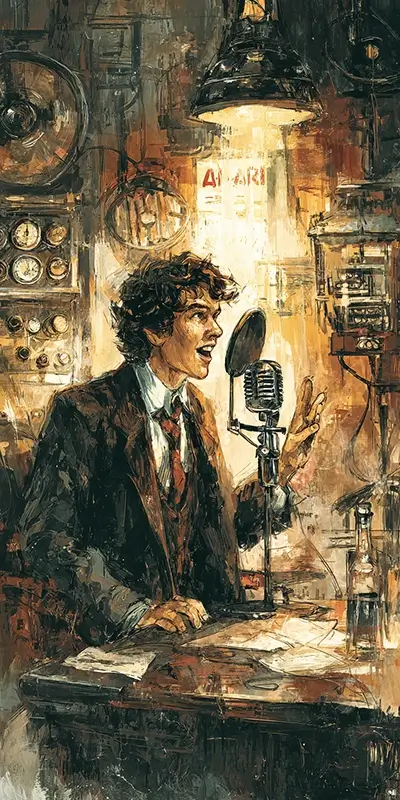
an close up young radio broadcaster speaking live into a large vintage 1930s studio microphone during a classic radio program
card 3

Music, Soap Operas and the Birth of Everyone

Here is where the story gets really interesting — because up to this point, the radio was still being thought of mainly as a long-distance communication tool. A better telegraph. A ship-to-shore device. It took a while for people to come up with the idea that would truly turn it inside out: what if instead of sending out messages to specific people, you simply broadcast? What if you just put on a program and let anyone who wanted to tune in, tune in?

The first proper radio stations started popping up in the early 1920s, and they caught on faster than anyone had expected. Music was the first thing that really took off — suddenly a jazz band playing in a studio in New York could reach out to a farmer in Kansas who had never set foot in a city. Then came the news broadcasts, the sports commentary, the variety shows. And then — the soap operas. Sponsored by soap and detergent companies trying to reach housewives at home, these serialized dramas pulled in millions of devoted listeners who would plan their whole day around not missing an episode.

What was opening up here was something entirely new in human history: mass culture. For the first time, people who had never met, who lived thousands of miles apart, who came from completely different backgrounds, were sharing the same stories, the same songs, the same jokes. A sense of being part of something bigger — a national conversation, a collective experience — was slowly taking shape. And it all came through a speaker the size of a breadbox sitting on a shelf in the corner of the room.

🔊 Listen & Practice This Card — The Family, the Living Room and the Box That Talked Practice shadowing: read while listening and repeat. Then write down a few expressions or sentences that stood out to you.
Speed:
0:00 / 0:00
Ready to play
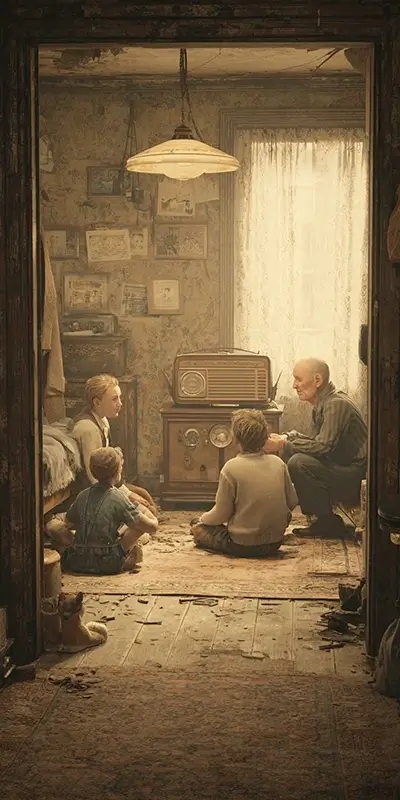
an ordinary family evening in the 1930s centered around a radio
CARD 4

The Family, the Living Room and the Box That Talked

Think about what an ordinary evening looked like for a family in the 1930s before the radio had really taken hold. After dinner, people would read, or talk, or simply sit. Entertainment meant going out — to a concert, a theatre, a cinema. The home was a quiet place. Then the radio showed up and turned the living room into something else entirely.

Families would gather around the set after dinner the way people today gather around a television — or used to, before everyone retreated to their own screen. The children would sit on the floor. The parents would settle into their chairs. And for an hour or two, everyone in the room was sharing the same experience at the same time. A comedy program that made the whole family laugh together. A news bulletin that made everyone go quiet. A football match that had the father jumping out of his seat while the mother pretended not to care and definitely cared.

What is easy to miss when we look back on this is just how deeply the radio worked its way into the daily rhythm of life. People built up their whole routines around it — what time they woke up, when they had breakfast, how they wound down before bed. The radio didn't just entertain. It structured the day. It gave families a shared soundtrack, a common reference point, a reason to be in the same room at the same time doing the same thing. It was, in ways we perhaps didn't fully appreciate until it was gone, a technology of togetherness.

🔊 Listen & Practice This Card — The Last Fire We All Sat Around Together Practice shadowing: read while listening and repeat. Then write down a few expressions or sentences that stood out to you.
Speed:
0:00 / 0:00
Ready to play
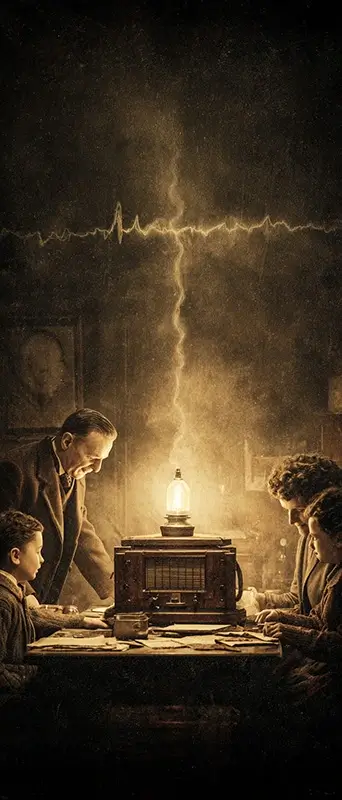
illustration of the first transatlantic wireless signal in 1901. On one side of the image, a powerful transmission station in Cornwall, England sends out glowing radio waves into the sky
CONCLUSION

The Last Fire We All Sat Around Together

The radio eventually gave way to television, and television gave way to the internet, and the internet gave way to the smartphone. Each step in that progression brought more content, more choice, more personalization — and a little less of something that is harder to put into words. Because here is the thing about the radio that we only really understand now, looking back: it was the last mass medium that truly brought people together in the same place at the same time around the same experience. Television started to pull that apart — suddenly different family members wanted to watch different things, and the fights over the remote control became a whole genre of domestic comedy. The internet finished the job. Today, everyone in a household can be sitting in the same room and living in completely different worlds — each one plugged into their own feed, their own playlist, their own algorithm-curated reality. We have more access to more content than any generation in history, and yet the experience of sharing a moment with the people around us has become something we have to actively choose and work at, rather than something that simply happened because there was only one box and it was on for everyone. The radio didn't see any of this coming, of course. It was just doing its best to reach out to as many people as possible. But standing at this end of the story, it is hard not to feel that something quietly slipped away somewhere between the family gathered around the wooden set and the family of five staring at five separate screens. The invisible wire connected the world. What it couldn't hold on to was the room.

Match the Telegraph Phrasal Verbs
0/16

Click one item in Column A and its meaning in Column B. Complete all pairs.

Column A – Phrasal Verbs

Column B – Meanings

Alessandra Fernandes Nóbrega
History teacher and educational content creator. M.A. in History of Education (UFPB). Creator of WeeklyCross, FlipVerbs and Flowglish — a connected ecosystem for learning English through context, not memorisation. Trained in educational entrepreneurship in Finland.

WeeklyCross teaches phrasal verbs through historical and cultural context. Each lesson connects to vocabulary practice on FlipVerbs and fluency levels on Flowglish — forming a complete learning ecosystem.

0%
Scroll to Top