Writing for the Masses
Think about it — for most of human history, nobody wrote anything down. Knowledge was simply passed down through stories, songs, and the voices of elders. Communities relied on memory to hold on to everything that mattered: recipes, laws, legends, rituals. And honestly? It worked, for a long time. But as civilizations grew into something bigger and more complex, memory alone just wasn't enough anymore.
Writing had already come about in ancient Mesopotamia and Egypt, which was a huge leap forward. The problem, though, was that producing texts in large quantities was still incredibly slow and expensive. Scribes took on the job of copying documents by hand, one page at a time, and the whole process simply wore out even the most dedicated among them. It was clear that society needed to look for better ways to put out knowledge — ways that could actually keep up with a growing, curious world.
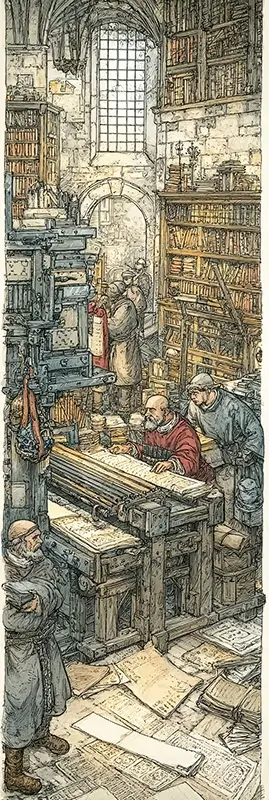
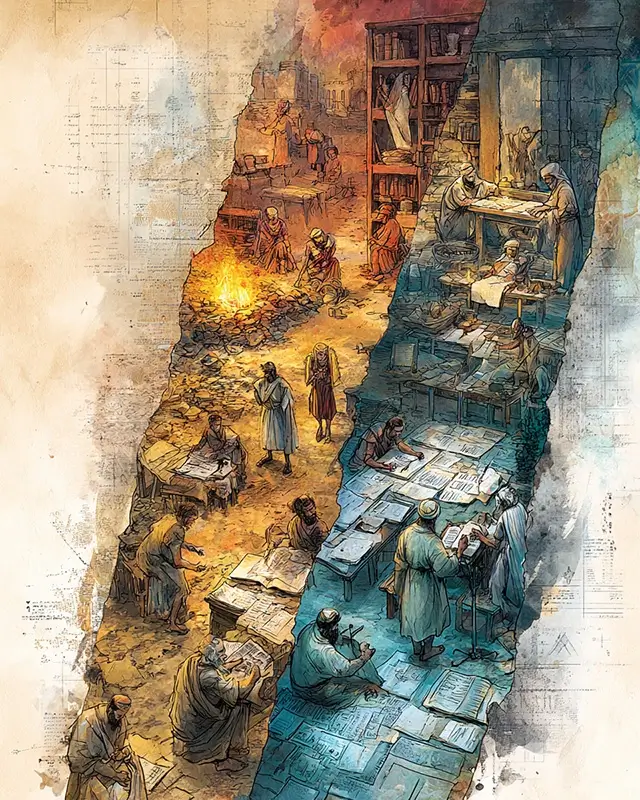
That's exactly where this page picks up. We're going to go through three game-changing moments that built on each other in fascinating ways: the medieval monks who gave up their comfort to copy manuscripts, the brilliant Gutenberg who came up with the printing press, and the bold encyclopedists who set out to sum up all of human knowledge in one place. By the end, you'll see how each of these stories fed into the next — and how they all led up to the world of information we live in today.